Principles of Business Writing
August 2025
Today I want to talk to you about something that we often take for granted but that is essential for any professional: written communication.
I recently took a very comprehensive course on LinkedIn Learning on Principles of Business Writing. As designers, developers, and technology professionals, our ability to communicate clearly and effectively is as important as our technical knowledge. It's not just about writing a brief or an email, but about building relationships, persuading stakeholders and ensuring that our ideas are understood and valued.
The Objective of Writing in the Business World
The main lesson of the course is that business writing is not the same as creative writing. Here, every word has a purpose: to be essential, concise, and easy to read. The audience we are addressing (our bosses, clients, or teammates) is busy. They are short on time and quickly scan messages for key points. If our message is not clear, simple and direct, we run the risk of being ignored.
The 10 Fundamental Principles for Effective Communication
The course presents a "10 C's" framework that I found extraordinarily useful for structuring any type of written communication, whether it be an email, memo, or report.
- Complete: Did you provide all the necessary information to avoid an unnecessary follow-up email?
- Concise: Did you eliminate extraneous words to get straight to the point? A good trick is to imagine that you are being charged for each word.
- Clara: Is your message so clear that it does not need to be interpreted? Make sure the vocabulary is understandable to your audience.
- Conversational: Does it sound like it was written by a human or a robot? The idea is a natural and personal tone.
- Polite: Is the tone of your message pleasant and respectful? A positive tone can make a big difference.
- Correct: Are the spelling and grammar impeccable? A message with errors projects an image of carelessness and lack of professionalism.
- Coherent: Do your ideas flow logically and are they well connected to each other? Transition words are your best allies.
- Considered: Is your document easy to read and visually appealing? The use of bold, lists, and headings helps guide reading.
- Concrete: Did you use specific details instead of vague words like “some” or “soon”?
- Credible: Are you backing up your claims with facts and reliable sources, rather than just your opinion?
How to Optimize the Writing Process
One point that resonated deeply with me was the importance of following a structured process. Most of us spend too little time planning and reviewing, and that's a mistake. An effective professional divides his time this way:
- Planning (40%): Analyze your reader. What do you know? What do you need to know? What is the purpose of the message?
- Writing (20%): The fastest part, once the planning is clear.
- Review (40%): Take some time, step away from the message, and then come back to review it several times.
This approach ensures that the message is clear, specific, and has the right tone for the audience, avoiding the most common mistakes.
The Importance of Choosing the Right Channel
The course also emphasizes something that in the digital world we sometimes forget: the channel matters. Not all messages are suitable for email. Sometimes a call is better for a confidential topic or a more fluid conversation. And, something I found especially valuable, is the power of a handwritten note. This simple and personal gesture can build stronger relationships with clients and colleagues, differentiating you from the avalanche of digital messages.
Final Reflection
This course reminded me that, regardless of the discipline, communication is a skill that never stops being perfected. Business writing is not about writing pretty, but about writing with a clear purpose. It's about respecting the reader's time, being precise, and building credibility in every word. It's a skill that I will undoubtedly take into my daily practice in user experience design.
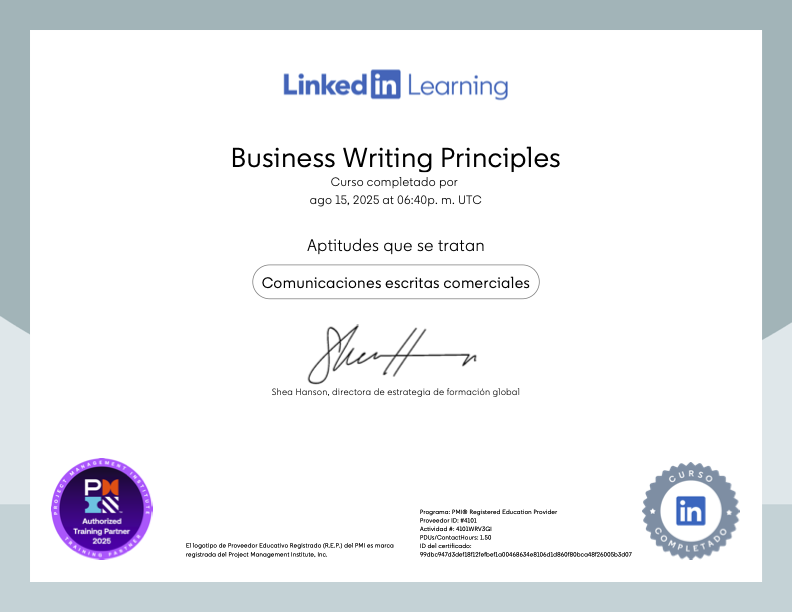
I would like to share with you the certificate I obtained, to validate the importance I give to continuous improvement in areas that directly impact my work as a designer.
Thanks for reading.