The importance of formulating hypotheses in experience design
March 2024
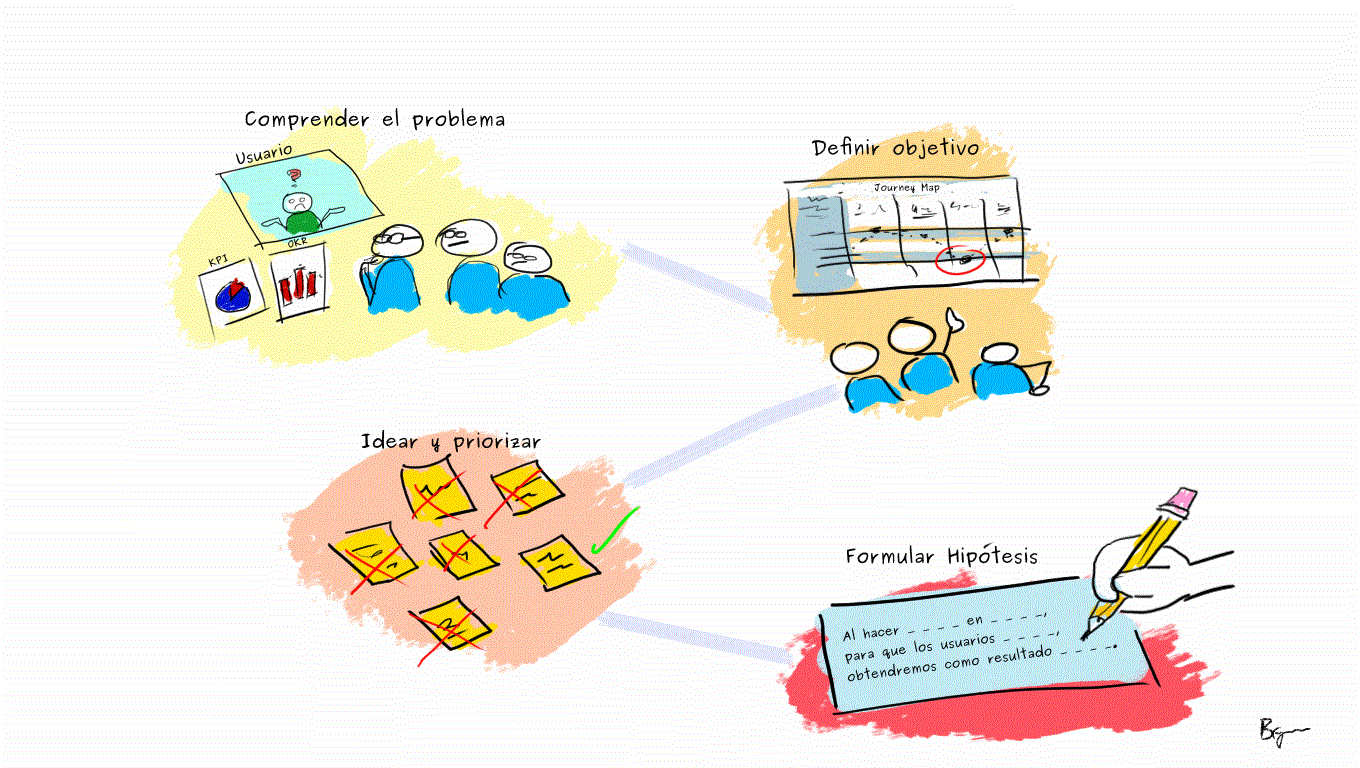
The experience design process is much more than simply creating attractive interfaces; It's about understanding user needs and how to best meet them. In this sense, hypotheses play a fundamental role in establishing a solid basis for decision-making and directing our efforts towards specific objectives.
What are hypotheses in experience design?
Hypotheses are statements based on assumptions that guide our actions and decisions in a design project. They help us clearly establish objectives and question our ideas with evidence. Additionally, they encourage team participation from the early stages of the project by aligning them around the defined objectives and how to achieve them.
Recommendations for formulating effective hypotheses:
Understanding the problem:
Before formulating hypotheses, it is crucial to understand the context in which the problem to be solved arises. This involves knowing key business metrics (OKRs and KPIs) and collecting information through research with stakeholders and users. For example, if the goal is to improve customer satisfaction on a web platform, we could analyze feedback from Net Promoter Score (NPS) or satisfaction surveys to identify specific areas for improvement.
Definition of objectives:
Once the problem is understood, it is important to clearly define the objectives to be achieved. This could involve identifying areas for improvement based on user feedback, such as improving a specific interface element that is causing dissatisfaction.
Generation and prioritization of ideas:
With the objectives established, ideas can be generated and prioritized to address the identified problem. It is essential to involve the team in this process and consider different approaches to find the most effective solution.
Formulation of hypotheses:
Once the most promising idea has been selected, a hypothesis must be formulated that describes the proposed changes and expected results. It is essential that these hypotheses are specific, measurable and relevant to the project objectives. For example, we could formulate a hypothesis like:
Al agregar un botón en el PopUp de la página de inicio que permita a los usuarios cerrarlo permanentemente, aumentaremos en un 10% el NPS de satisfacción de los clientes en el primer mes
Additional recommendations:
It is important to remember that the design process is iterative and incremental, so assumptions may be adjusted as the project progresses and more information is obtained.
It is essential to validate hypotheses through tests and experiments with real users. This will allow us to confirm whether the proposed changes are having the desired impact and adjust our strategies accordingly.
Hypotheses are not static and can change based on new insights and learning obtained throughout the design process. Therefore, it is important to be open to reviewing and adjusting our assumptions as we progress through the project.
In summary
Formulating effective hypotheses is critical to the success of any experience design project. They help us set clear goals, make informed decisions, and validate our ideas with evidence.
By following the above recommendations and maintaining an open and adaptable mindset, we can create meaningful and satisfying experiences for our users.
Thanks for reading.