First Steps in Electronics: A Journey of Lights, Pulses and Doors
June 2022
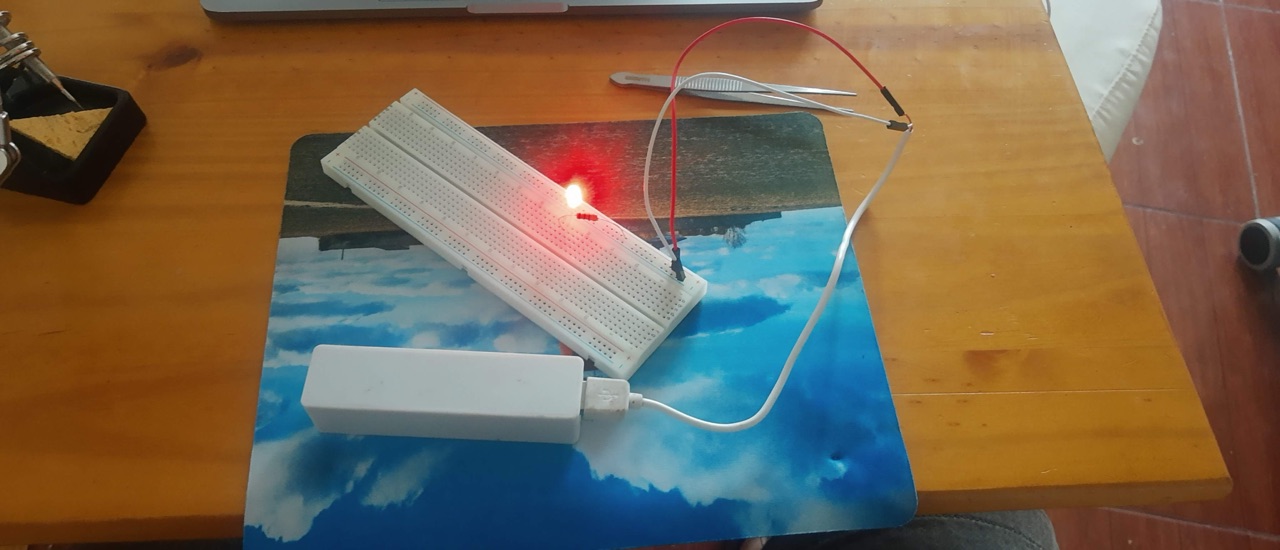
In this post, I want to share with you my first steps in the fascinating world of electronics. From the simple act of turning on an LED to building more complex circuits, each experiment has been an opportunity to learn and grow.
Lighting the way: The first LED
The beginning of any learning in electronics usually involves turning on an LED. It seems simple, but in that small flash of light all the magic of making electricity obey our will is condensed.
Modulating light: Controlling the intensity of the LED
Once the basic ignition was mastered, the next step was learning to control the intensity. Using potentiometers and transistors, I was able to adjust the luminosity, discovering how small changes in voltage produce significant variations in visual perception.
Binary and sequences: LM555 and 7490 working together
Integrating timers and counters opened the doors to the digital world for me. The LM555 chip generating pulses and the 7490 counting sequences was my introduction to applied binary language.
Precise pulses: The LM555 in monostable mode
Setting the 555 to monostable mode allowed me to generate pulses of exact duration. Fundamental for applications where timing is critical.
Automation: Testing an electric gate
All this knowledge culminates in practical applications. Controlling an electric gate was my first real automation project, integrating sensors, timers and actuators.
Conclusions and next steps
Electronics is a vast field where each project teaches something new. These first steps barely scratch the surface, but they laid the foundation for more complex projects.
Thanks for reading.